

A Simple Framework for Pitching Deep Tech Investors
How to make your progress legible to investors who don't have a map for where you are.
Fundraising is hard enough when you’re building SaaS. In deep tech, it’s harder, because most investors don’t have a map for where you are or how far you’ve come. There’s no ARR chart, no CAC:LTV ratio, no well-worn playbook. Most deep tech founders walk into a pitch and assume their numbers will speak for themselves. They rarely do.
After hundreds of deep tech pitches, the ones that land all have one thing in common. The founder defines the evaluation criteria before presenting the results.
In the absence of a standardized framework, the smartest founders write their own rubric and walk investors through it before showing a single number.
Here’s what that looks like in practice.
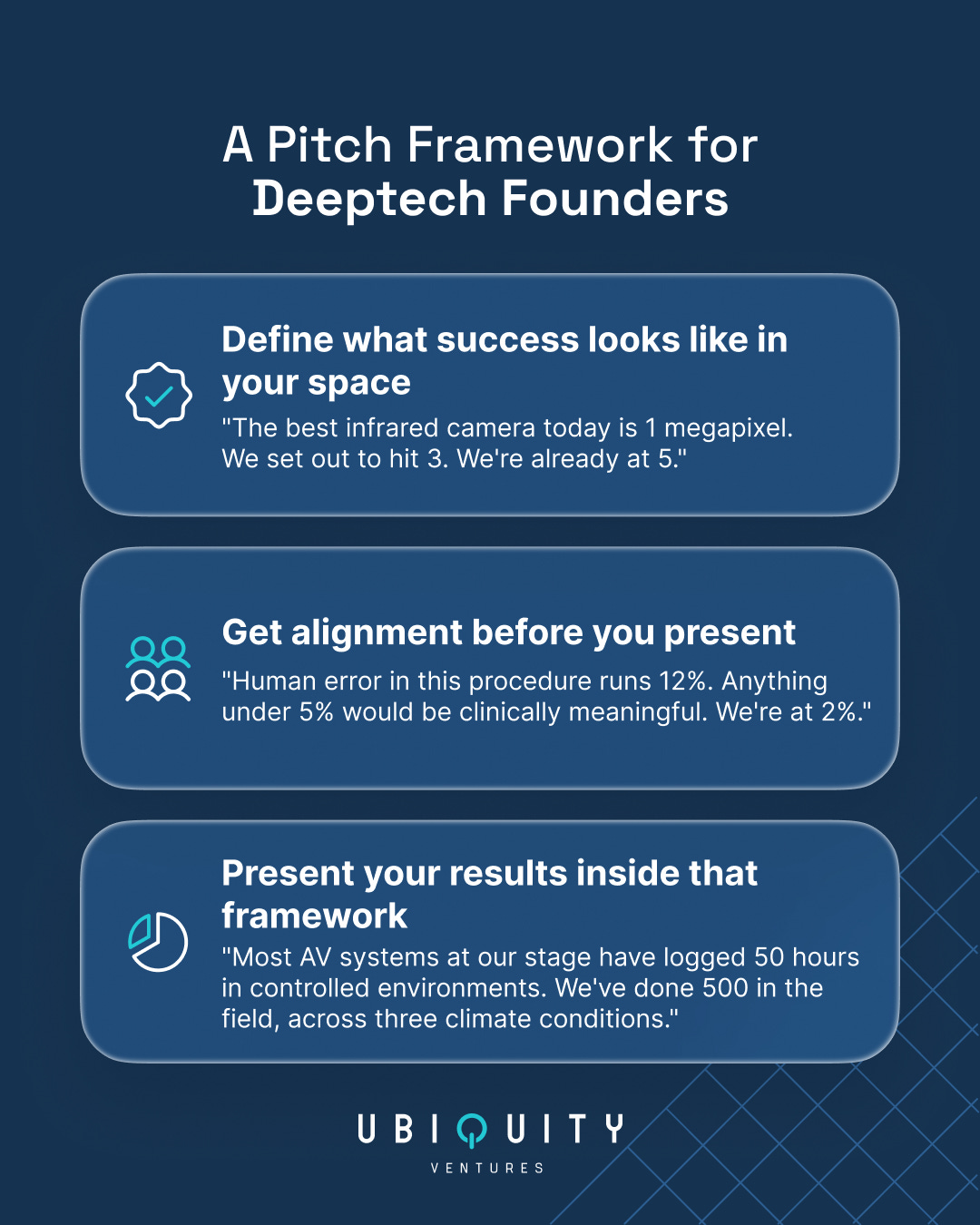
Step 1: Define what success looks like in your space
Before you show any results, give investors the context to interpret them. What does the state of the art look like today? What milestone were you originally aiming for? What would a meaningful leap actually mean in your field?
This matters especially in physical AI and “software beyond the screen” categories, where the metrics are physical and unfamiliar: megapixels on an infrared sensor, cycle time on a robotic arm, latency on a hardware inference stack. A VC with a SaaS background has never thought about any of these. Your job is to make your progress legible before you present it.
For example: if you’re building a surgical robotics system, don’t open with your accuracy rate in isolation. Open with what the current standard of care looks like, what human error rates are in that procedure today, and what improvement would actually matter clinically. Now your number has a home.
Step 2: Get alignment before you present
Once you’ve framed the criteria, make sure your audience is with you before moving on. A simple gut check (”Does that baseline make sense to you?”) goes a long way. If investors don’t agree with your starting point, your results won’t land, no matter how strong they are.
For example: if you’re building in autonomous vehicles, anchor to the SAE autonomy levels before presenting your results. Once an investor understands that most commercial deployments are still at Level 2, your Level 4 milestone in a constrained environment carries real weight.
Step 3: Present your results inside that framework
Now show your numbers. With context established, milestones carry weight. Investors can see not just what you achieved, but how it compares to what was previously possible, and what it signals about your trajectory.
For example: instead of “we’ve completed 500 hours of field testing,” try “most systems at our stage have done 50 hours in controlled environments. We’ve done 500 in the field, across three different climate conditions.” Same number, completely different signal.
Use this in your pitch deck, in early investor conversations, and any time you’re asked to explain what you’ve built. The goal is the same every time: give your audience the criteria before you give them the results.
The infrared camera example
Founder, version one: “We built a 5-megapixel infrared camera.”
VC: blank stare.
Founder, version two: “The most advanced infrared camera available today is 1 megapixel. We raised our initial funding with the goal of hitting 3. We’ve already blown past that and reached 5.”
Same milestone. Completely different reaction. The second version works because the criteria come first. The investor can see not just a number, but a leapfrog over the state of the art, and a team that set a goal and exceeded it.
What deep tech investors wish more founders knew
Deep tech fundraising is fundamentally different from raising for a software company. You are often the only person in the room who understands what your numbers mean. Defining the scorecard before you show the score is how you close that gap.
The best deep tech founders treat this the same way they treat founder-market fit. Knowing the problem deeply is only half of it. The other half is being able to bring others inside that understanding. If you’re a VC who encounters deep tech deals outside your core thesis, this is the framework worth sharing with your founders before they pitch.
Ubiquity Ventures is a seed-stage venture capital firm investing in software beyond the screen. We back founders building AI, software, and smart hardware for the physical world — technology you can touch, hear, and feel.
If you know a founder working on something nerdy and early, we’d love an introduction.