

Before the SpaceX IPO: The Culture Lessons Every Deep Tech Startup Should Steal
What a SpaceX engineer-turned-deeptech VC reveals about culture, speed, and defensibility in deep tech

SpaceX just filed for its IPO. Most of the coverage will focus on rockets, Starlink, and financials. That’s fine—but it misses the real story: how SpaceX builds.
For our latest Ubiquity University module, I just sat down with Brannon Jones, a former SpaceX manufacturing engineer who worked on Falcon and Raptor and is now a deeptech VC at AlleyCorp, to unpack what actually makes SpaceX different from the inside. Not the mythology—the operating system. The consistent theme:
SpaceX has turned culture into a compounding execution engine.
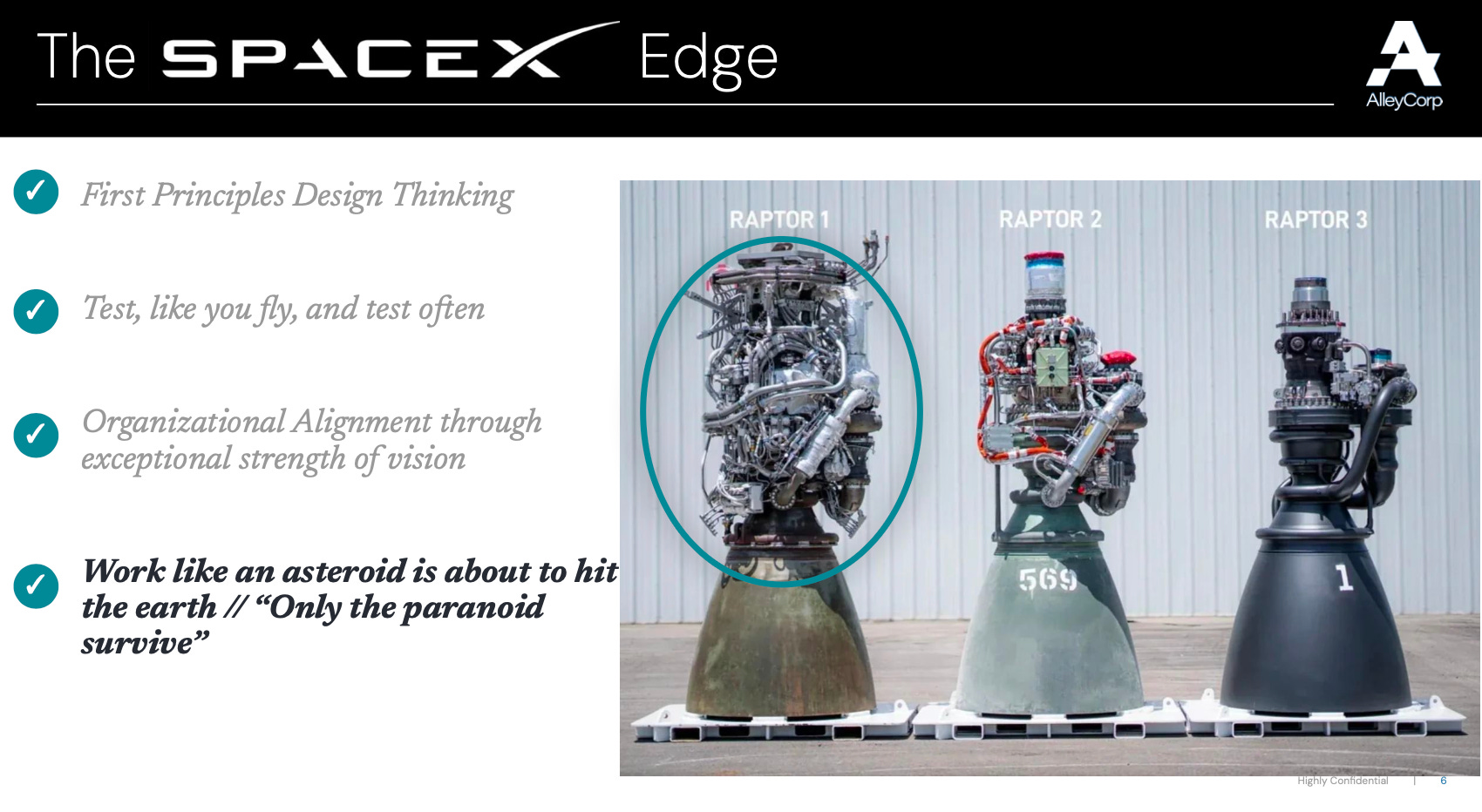
1. Test Like You Fly. Test Often.
SpaceX prioritizes truth over elegance. Instead of trying to design the perfect system upfront, they push hardware into real-world conditions as quickly as possible. That includes tests that fail—sometimes visibly and dramatically—but internally, those are treated as progress because they collapse uncertainty.

The contrast with legacy aerospace is sharp:
Design extensively to avoid failure
Optimize before validating
versus:
Build quickly
Test in reality
Iterate based on actual data
This approach compresses timelines and eliminates false confidence. In deep tech, especially in the physical world, you cannot simulate your way to certainty.
2. Ruthless Elimination of the Unnecessary
One phrase Brannon emphasized was avoiding anything “superfluous.” In practice, this is much harder than it sounds, but the mantra is “delete, delete, delete”. Most teams overbuild because they assume they understand the system early.
SpaceX assumes they don’t.
They start from first principles, keep designs as simple as possible, and let real-world testing determine what needs to exist. That discipline leads to systems that are cheaper, faster to build, and easier to improve.
A useful heuristic:
If your roadmap feels fully specified, you’re probably overbuilding.
If parts of it feel unresolved, you’re likely learning in the right places.
3. Manufacturing Is the Innovation Engine
A key insight from Brannon: SpaceX’s velocity is driven as much by manufacturing as by design. High-throughput production of complex components creates a rapid feedback loop between building and learning.
Faster builds → faster tests → faster insights → faster redesigns
This flips the typical mental model. Manufacturing is not downstream of innovation—it enables it. The faster you can produce and iterate, the faster you converge on better systems.
This pattern is increasingly visible elsewhere:
EV companies improving through production scale
Robotics systems learning through deployment
Hardware startups refining products in the field, not the lab
4. Extreme Clarity on Priorities
Another defining trait is how clearly priorities are communicated. At SpaceX, Elon regularly makes it explicit what the single most important thing at the company is, and that clarity propagates across the organization. Engineers, technicians, and new hires all operate with a shared understanding of the current objective.

This reduces friction in several ways:
Less time spent aligning
Faster decision-making
Fewer conflicting efforts
It’s not always perfectly clean, but the organization consistently converges around what matters. In complex technical environments, that clarity is a force multiplier.
5. Ground Truth Over Abstraction
SpaceX also places a premium on direct, firsthand information. Brannon described how leaders often bypass layers to understand what is actually happening on the ground. The goal is not polished summaries—it’s reality.
That creates a system where:
Issues surface earlier
Individuals closer to the work have real influence
Decisions are anchored in facts, not narratives
It also removes the ability to hide behind abstraction. The organization continuously orients itself toward what is actually happening.
Culture as a Moat
What ties all of this together is not any single tactic, but the system they create. Culture at SpaceX is not about stated values—it’s about how quickly the organization learns from reality and adapts.
Fast feedback loops
Direct information flow
Clear priorities
Continuous iteration
That combination produces something extremely difficult to replicate: a higher rate of learning.
In deep tech, that is the moat. Competitors can copy products, hire talent, and raise capital. But it is much harder to replicate how quickly a company improves.
When SpaceX IPOs, the market will try to value rockets. The harder—and more important—thing to value is a culture that learns faster than everyone else.
Watch the Full Breakdown on Ubiquity University
Brannon goes deeper on how these principles show up day-to-day inside SpaceX, and where they do—and don’t—translate to other startups.

Ubiquity Ventures — led by Sunil Nagaraj — is a seed-stage venture capital firm focused on startups building software that reaches into the real world. In a screen-obsessed world, we focus on "software beyond the screen" startups, which include technology companies that apply AI, software, and smart hardware to physical problems and systems that you can touch, hear, and feel.
If your startup fits this description, reach out to us.