

Gen 1 Hardware Is Brutal. Here’s How Halter Survived It (and Reached $2 Billion)
From early prototype pain to deploying over 1 million field devices: Halter's unfiltered playbook for first-generation hardware success.

Last week, Halter announced a $220M round at a $2B valuation. That headline is the result. This post is about the hardware development process behind it.
Today, we’re releasing a new Ubiquity University module featuring Halter’s VP of Product & Engineering, Andy McLaren, on one of the hardest problems in deeptech: shipping Gen 1 hardware. If you’re building “software beyond the screen,” this is where theory meets mud, rain, broken parts—and reality.
You can watch the full session, but below are Andy’s three hard-earned lessons after eight years of building collars that live on cows, outdoors, for 5–6 years straight.
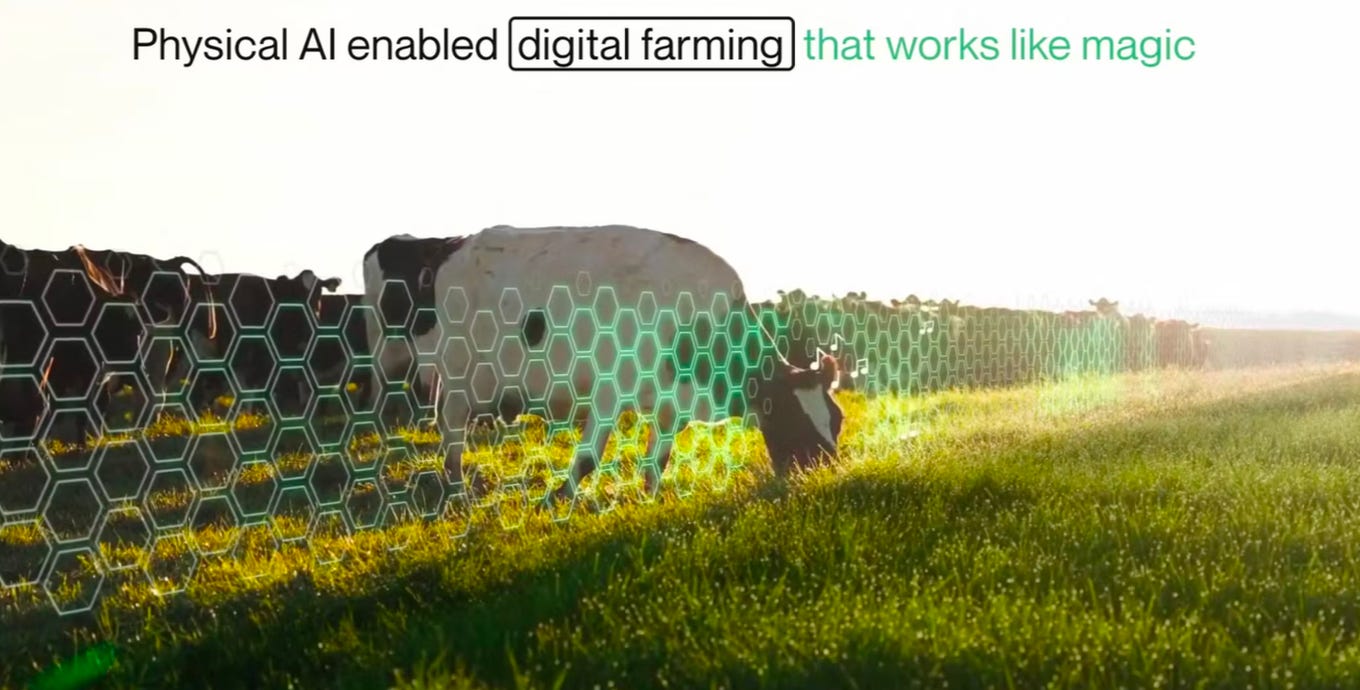
Lesson 1: Get to the real thing—faster than feels comfortable
Most teams iterate safely. Hardware punishes that instinct.
Andy’s core idea is to pull risk forward as aggressively as possible. The slides capture the progression well: rapid prototyping for fit and form, real materials for durability and function, and then integration as early as possible . But the real insight is how quickly you move through those stages—and how willing you are to abandon work.
At Halter, this wasn’t theoretical:
Early prototypes looked correct, but leaked water immediately
Vacuum-cast parts appeared production-ready, but tore apart in the field
Fully integrated systems exposed failure modes no one had even considered
Rather than polishing intermediate steps, they accelerated toward the “final” version. Within roughly two months, they scrapped an entire design path and jumped directly to real tooling and contract manufacturing.
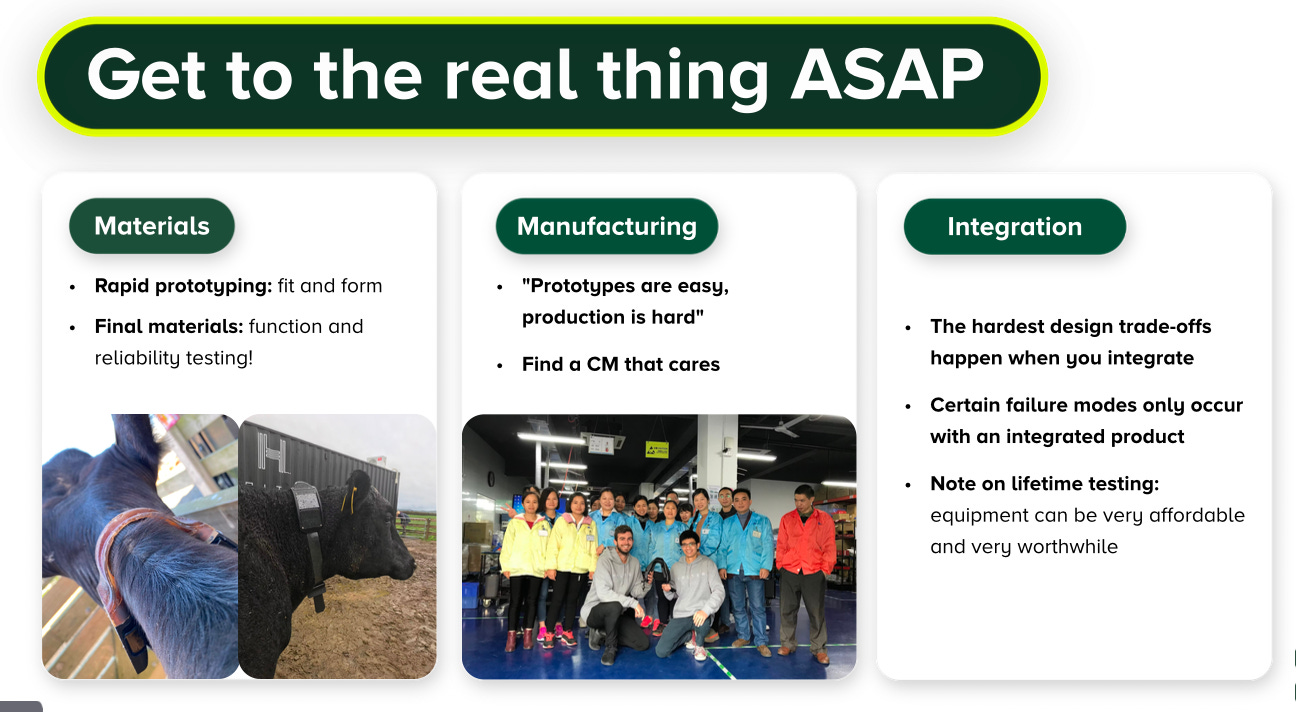
The uncomfortable truth is that the fastest way to learn in hardware is often to build something that looks finished—and then let it fail. Manufacturing, in particular, is not a downstream step. It is the product. As Andy puts it, “prototypes are easy, production is hard” .
Lesson 2: Selectively innovate (or waste years)
Early-stage teams, especially technical ones, have a bias toward innovation everywhere. Hardware companies don’t have that luxury. Andy’s second lesson is a discipline: be ruthless about where you innovate—and equally deliberate about where you don’t.
At Halter, the team focused innovation on the core problem: training animals with a collar and enabling virtual fencing. That’s the breakthrough. Around that, they deliberately avoided reinventing the wheel:
Used existing buckle designs rather than inventing a new attachment system
Leveraged experienced contract manufacturers instead of building novel processes
Bought off-the-shelf testing equipment instead of designing custom systems
One story captures this well. Early on, they built a beautifully simple “slip-on” collar—no buckle, seamless user experience, almost elegant in its minimalism. It also fell off the cow in about five minutes. Meanwhile, a standard buckle had been working reliably in the market for years.
They chose the buckle.
That decision sounds obvious in hindsight, but it reflects a deeper trade-off founders constantly face: ego versus progress. The winning teams innovate where it truly matters and show humility everywhere else.
Lesson 3: Track—and obsess over—field failures
Once hardware is in the field, the job changes. You’re no longer primarily building—you’re learning.
Andy emphasizes that many of the most important failure modes simply cannot be replicated in a lab. Real-world environments introduce edge cases you will never predict. The only way to improve is to instrument, observe, and debug relentlessly.
At Halter, this became a core competency:
Every deployed unit is monitored for performance
Failed devices are retrieved whenever possible
Root causes are investigated deeply and systematically
Failure modes are categorized and tracked over time
This image below shows a real distribution of failures—everything from corrosion to capacitor degradation to vent punctures . One particularly instructive example was a waterproof membrane vent that passed all lab testing. In the field, however, small blades of grass could work their way into the housing and puncture it. No simulation caught it. Only real-world exposure did.
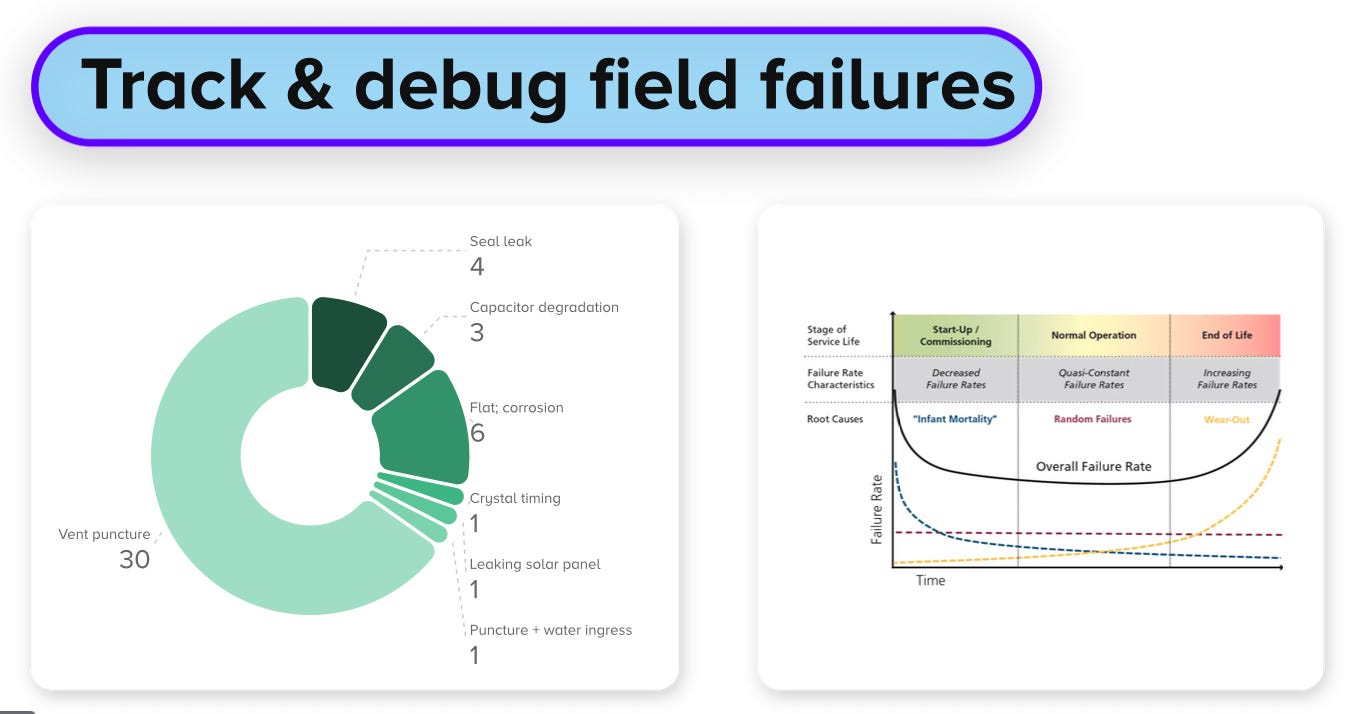
Because they had tight feedback loops, they were able to identify the issue, understand the root cause, retrofit deployed units, and fix future designs. That cycle—deploy, fail, learn, fix—is what turns Gen 1 into something durable.
Andy also highlights a useful framework for thinking about failures:
Infant mortality: early defects, often tied to manufacturing issues
Random failures: unpredictable environmental events
Wear-out failures: degradation over time
Each category behaves differently and requires a different response. Understanding which one you’re dealing with is half the battle.
Why this matters now
There’s a growing narrative that AI has made building companies easier. For software, maybe. For hardware, not even close.
If anything, expectations are higher. Customers don’t care how advanced your models are if your device leaks, breaks, disconnects, or fails in the real world. This is why we’re so focused on this category at Ubiquity. It’s where AI meets physics—and physics always wins.
Final thought
Halter didn’t reach a $2B valuation by getting Gen 1 right the first time. They got there by getting Gen 1 wrong quickly, learning faster than anyone else, and compounding those lessons in the real world.
If you’re building something that has to survive outside a data center—on a farm, in a factory, on a satellite, or in a hospital—you’re not just writing software. You’re shipping reality. And reality is an unforgiving customer.
If you want the full breakdown from Andy, the Ubiquity University session is worth your time. And if you’re building something that feels like software beyond the screen, we would love to hear from you.
Ubiquity Ventures — led by Sunil Nagaraj — is a seed-stage venture capital firm focused on startups building software that reaches into the real world. In a screen-obsessed world, we focus on "software beyond the screen" startups, which include technology companies that apply AI, software, and smart hardware to physical problems and systems that you can touch, hear, and feel.
If your startup fits this description, reach out to us.