

Six steps to rewiring your organization with AI - from WindBorne CEO John Dean
The real AI bottleneck isn’t models—it’s your org. Here’s how to fix it.

Here is a guest post from John Dean, Cofounder & CEO of Ubiquity-backed WindBorne Systems - they fuse data from their long-duration smart weather balloons with their AI models to produce the most accurate weather forecasts. We held a Ubiquity CEO-to-CEO event about John’s work on rewiring his own startup for AI and John wrote this post afterwards to summarize some of his key points.
Ever since Claude 4.5 Opus and other similarly powerful models came out at the end of 2025, it’s old news that individuals can get 10x or more boosts in their output when they know how to leverage it.
Many draw the analogy to human computers in the 1960’s and how a modern spreadsheet on a laptop is faster than entire skyscrapers of human computers. And imagine if one cell of that spreadsheet had to be manually computed by a human: it would bottleneck the entire sheet by orders of magnitude, waiting for the one step that needs human attention. That’s how many agent-powered systems are today: incredibly fast and powerful, but still bottlenecked by the required human steps. This is even worse at the organization level.
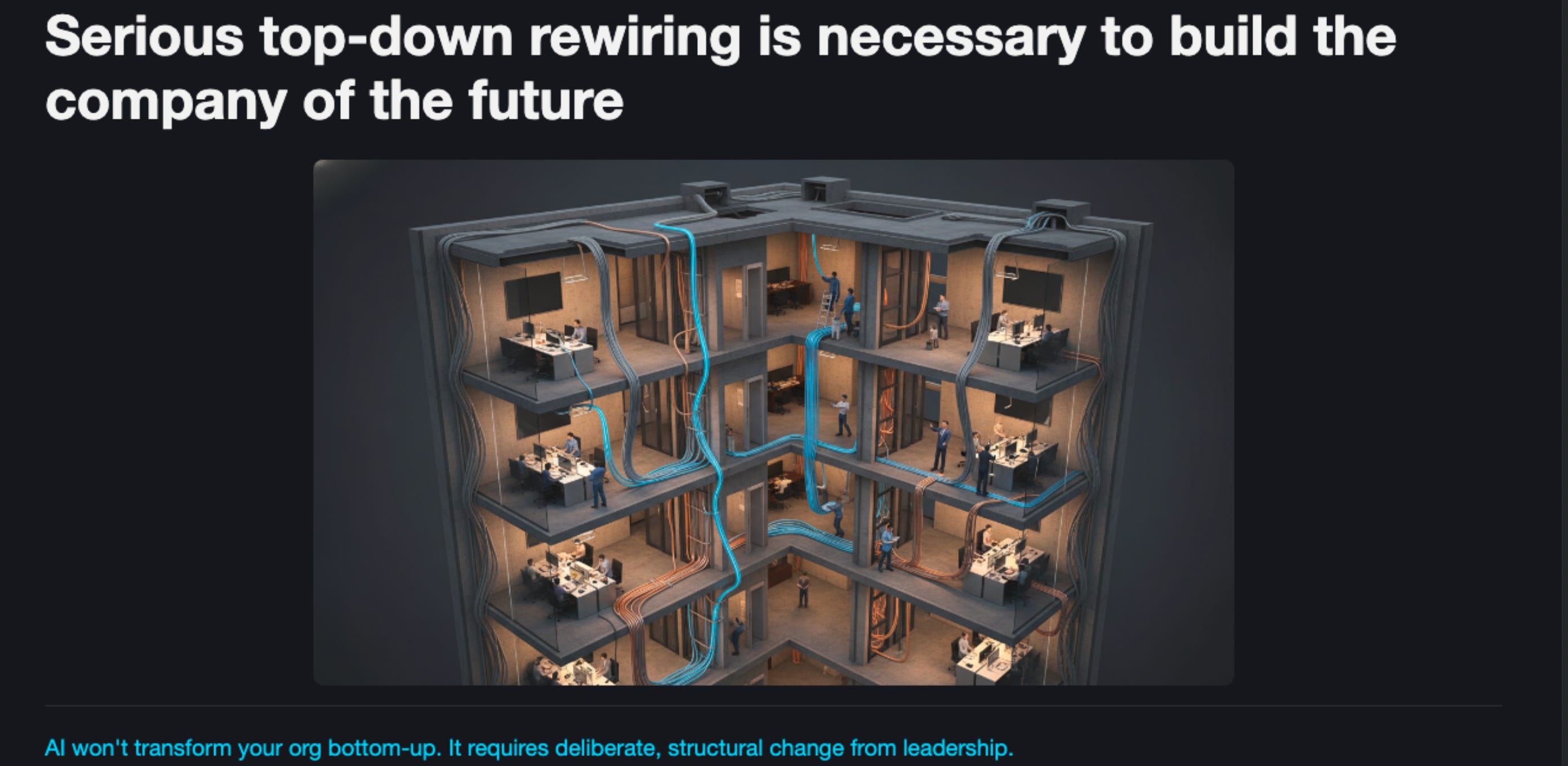
So, in an organization, how do we remove the human bottlenecks on this spreadsheet?
This is the trillion dollar question, and we can’t answer it without next generation models. But we also need to change our organizations.
The first step is that everyone in the organization needs to be on the same page and using AI. This is easier said than done.
I see plenty of CEOs pounding the table and writing memos about how they demand AI usage. And many of them are good memos. But it’s not helpful to just be demanding: how is everyone in the org supposed to use AI? For some roles, it’s easy, but for others, it’s much harder. Put yourself in the shoes of an employee: this whole revolution is a bit terrifying in the first place, changing how you work is hard, and often it’s unclear how to get the real productivity gains. Making matters worse, even if you you are good at individually using AI, you are bottlenecked by all the human communication in the org, and the AI doesn’t have the tooling to navigate it.
I have an idea: let’s just fire everyone who isn’t AI-pilled and addicted to this stuff like us!!!
Those LOSERS are just going to get left behind!! Sucks to suck.
No, of course not. That would be a disaster while your org relies on load-bearing human positions, and it’s unnecessarily unfair to humans who are slower to change. Your senior security engineer might be less inclined to use AI because of how much security risk AI introduces.¹ And if you fire your security person who is incredibly smart and knowledgeable but just hasn’t seen the light on AI yet, and you haven’t properly invested in showing it to them in a fun, caring, compassionate way, you’re an idiot.
¹ True of any new tool, and proportional to the power of the tool.
The answer: Socially engineer your org to use AI
Step 1: Agents in the chat app
If you want your org to use AI better, it needs to be a social thing. The problem with current AI tooling is that it is incredibly individualistic. Humans are social creatures, we pick up on signals, we want to signal about things we care about, and we rely on the direction of the herd for 90% of our behavior. If you want AI use to spread organically, it has to be social.
Unfortunately robotics in the workplace is a ways behind LLMs. So, we need to get AI usage directly in your primary company chat app. For most startups, this is Slack. I personally hate Slack and use Zulip instead², but there are plenty of solutions for getting AI agents in Slack nowadays: go read up on it and find one that works.
Some people mistakenly think that the purpose of having agents in Slack is convenience. It’s lower friction to send a message in Slack than to open a code terminal or go to claude.com. But if anything Slack is a worse interface than a dedicated UI, so conversing with it there runs the risk of becoming a crutch.
But the value of agents in your chat app is the social experience. The goal is to build a group chat that is a symbiotic combination of humans and AI agents, conversing natively in a single town square.
The point of agents in the chat app is to build social dynamics, not convenience.
² See my post on zulipllm for a small taste of why Zulip is so much better.
Step 2: Keep important discussions public
The biggest hurdle that one runs into with agents is information security and privacy. If the agent has access to private conversations, and it has any form of memories, you are in for a bad time unless you are really careful. Being careful slows things down and makes it less fun, so you want to build things to be inherently safe.
The solution to this is to only give these social agents access to public channels. This also means that you have to actually be having useful conversations in public. WindBorne was already built this way, so it was easy for us. I hate the mental overhead of thinking about who can see what, so I’m just radically transparent except for the minimum necessary set of sensitive information. I believe part of what made this possible was Zulip’s core features of topics within channels.
Step 3: Put your money where your mouth is
You’re going to need to spend a lot on tokens. This has already been widely talked about. But I also mean that you need to assign some of your best engineers to building good AI infrastructure. You can’t just plug in a SaaS product and call it a day, and you can’t just hire someone new to do it for you: someone needs to deeply understand how your system works and build tooling around it. Plan to hire additional people to keep expanding things along the way, but it starts with an existing engineer.
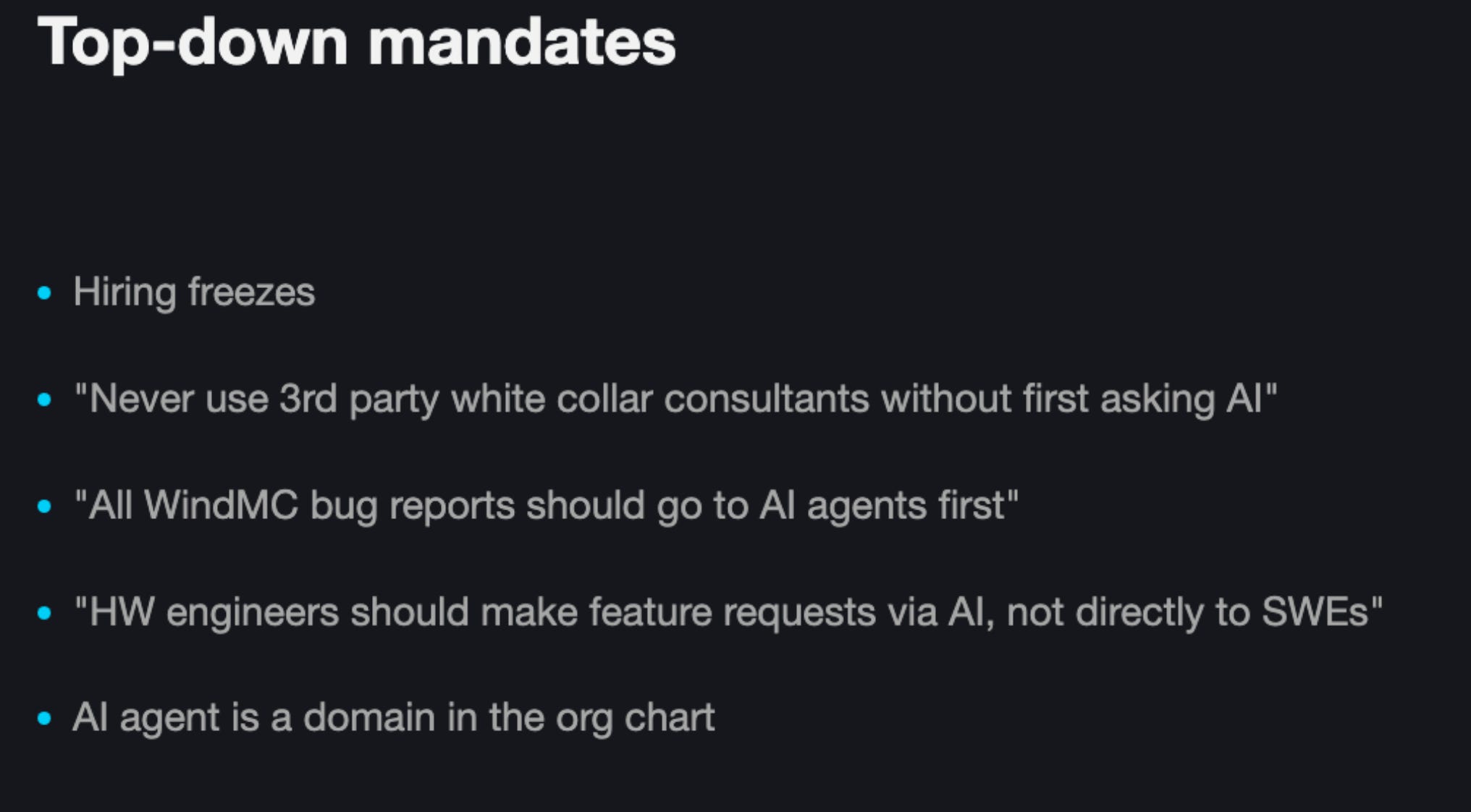
At WindBorne, I reassigned one of our best engineers, Davy Ragland, to this full time. It was a real cost to what he was previously working on and required others to step up. But he built SHODAN, our primary internal AI agent, and it paid off enormously. Treat it like they quit their old job, and commit to the change.
Step 4: Make your org searchable by agents
In order for agents to be useful, they need context. Unless you give them the tools to find context the way you would onboard a human, they won’t seem that useful. This is at the root of a lot of the problem with individual AI use: every individual has to learn on their own how to give the AI context.
Today this looks like setting up a bunch of MCPs and command line tooling to give agents access to things. Most important of all is message search: if you want them to be able to act native in your chat app, they need to be able to find messages like a human can. At WindBorne, after doing step 3 in this guide, the first thing we did was build out and optimize vector search of all Zulip messages for both humans and agents to use.
Step 5: Lead by example in public
This one is pretty straightforward: you set up agents in your chat app. They have access to information, and infrastructure to support them. Now lead by example and ping the AI when relevant in conversation. Build the muscle and the habit. Even if it’s set up well, and even if you’re a big fan of AI, it takes some effort to change habits, and it’s important you demonstrate this yourself.
Step 6: Bake in usage
If you did steps 1-5 well, AI agent usage in your chat app should already be spreading through your org like wildfire. At WindBorne, we quickly grew to $20k / month spend with SHODAN (and then made some optimizations to manage spend, but even at that cost it’s well worth it).
But, there may be pockets it doesn’t reach as much, and if you’re investing less time and energy than I did, results may be more muted at first. So you want guaranteed entry points to social AI usage.
The best example I have is that we made SHODAN be the onboarding buddy for every new hire. Now, no matter what background you come from, even if you only played with a free-tier model 9 months ago and thought it sucked (they do), when you join WindBorne you get the sci-fi experience of interacting with a top-tier model, with all the right context loaded up, operating natively in a UI that was otherwise designed for humans. This sets you up for success from day 1.
A note on security and caution
Any time an agent can cross an information security boundary, there are risks. So in this post, I advocate for giving your agent access to all internal public-visibility messages. But this means the same bot can NOT have inbound information from people outside the org, and it shouldn’t be able to see DMs.
Consider the visibility levels of the following 3 things, ordered by level of privacy:
A DM between two people in your org
A public channel in your org’s chat app
The open internet
A current-day AI agent shouldn’t be able to write to a lower level if it has access to information from a higher level, unless there is meticulous infosec design and monitoring. If it can read your DM, then it shouldn’t be able to post in public in your org, because then it can leak information. And each set of DMs has individually mutually exclusive privacy, so a bot that has memory and is active across all DMs is a nightmare to manage, unless you know what you are doing.
Email is an interesting subject: it’s private read, but there is essentially public write access: anyone can just email you. This means that an AI that is reading all of your emails as they come in is susceptible to prompt injection attacks.
I don’t write this to scare anyone away from playing around. Early humanity had to literally play with fire to harness its power and get to where we are today. Take these notes on security as reason to learn more yourself, not reason to shy away.
Where from here?
The AI singularity is going to transform everything, that much is obvious. But it’s very hard to predict exactly how and when specific things will change.
If you are a CEO, you need to be plugged in and playing around every day. You cannot just buy some off-the-shelf SaaS wrapper for AI and expect it to plug in seamlessly. You need to re-wire your org with AI. Only the CEO has the vantage point and authority to execute on this: don’t let your team down.
This was a guest post from Ubiquity-backed WindBorne Systems Co-founder & CEO John Dean.
Ubiquity Ventures — led by Sunil Nagaraj — is a seed-stage venture capital firm focused on startups building software that reaches into the real world. In a screen-obsessed world, we focus on "software beyond the screen" startups, which include technology companies that apply AI, software, and smart hardware to physical problems and systems that you can touch, hear, and feel.
If your startup fits this description, reach out to us.