

What Deep Tech Investors Are Watching in 2026
Six investors on where the real moat is being built in 2026.

We asked a handful of deep tech investors two questions: What are your hot takes on deep tech in 2026, and is deep tech more or less exposed to AI than SaaS?
Deep tech is having a moment.
What used to be a niche corner of venture now draws serious capital and attention, as investors hunt for the kind of durable moats that are getting harder to find anywhere else. When software is cheap to build and quick to copy, the advantage moves to the problems that stay hard.
Most of the investors pointed to the same shift. The action is moving from software on a screen to AI in the physical world, where the hard problems are energy, robotics, sensors, compute, and the infrastructure that lets any of it run. And almost everyone agreed that deep tech is harder for AI to flatten than SaaS, because you still need the robot, the grid, and the proprietary data.
A few pointed to where the next edge gets built, in regulated industries like energy, defense, and healthcare, and in the rush of generalist investors now crowding into the category.
Then the takes split: one investor thinks the biggest new risk to deep tech has nothing to do with technology at all.
Thanks to Lu Zhang, Adam Draper, Reilly Brennan, Julie Lein, and Rob Toews for sharing what they’re watching. Here’s where they landed.
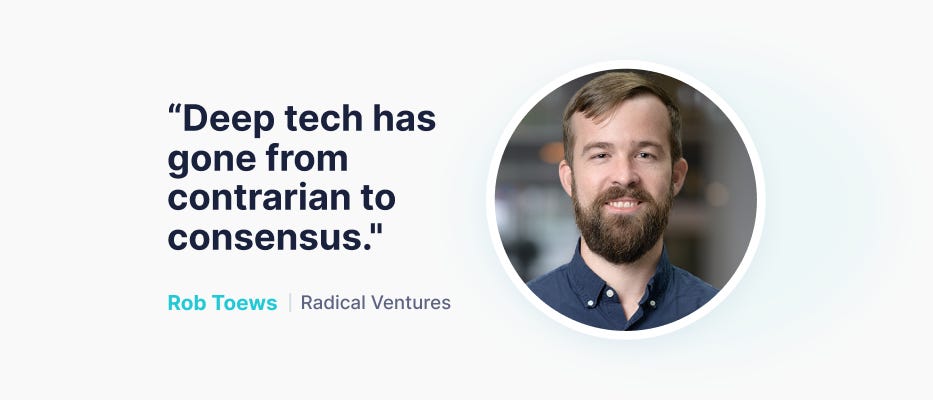
Rob Toews, Partner, Radical Ventures
“In 2026, breathtakingly quickly, deep tech has gone from contrarian to consensus. The SaaSpocalypse narrative and the breadth of Anthropic and OpenAI’s competitive blast radius has pushed many VCs and entrepreneurs to focus on areas that feel less vulnerable to Claude’s near-term roadmap, including a lot of hardware. Space, semiconductors, robotics, bio, brain-computer interfaces, these have all seen a massive surge of interest and funding in recent months.”
For Rob, it’s a homecoming. “In a way, it is a return to venture capital’s most pure and true roots.”
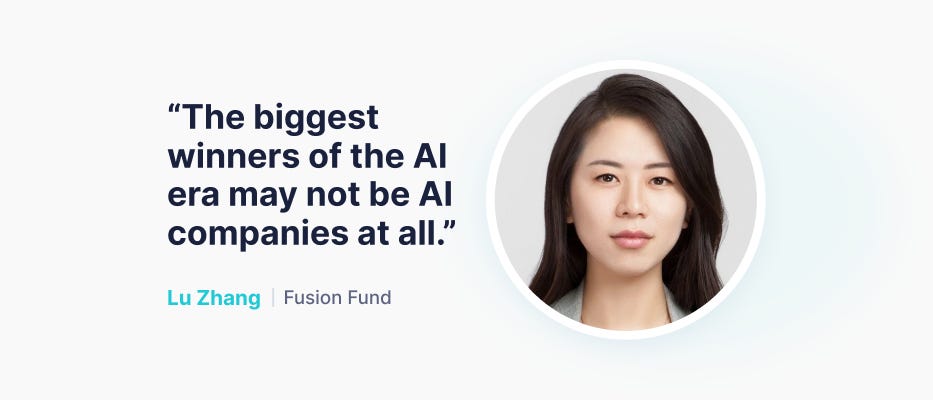
Lu Zhang, Founder & Managing Partner, Fusion Fund
“We’re witnessing a shift from digital AI to physical AI. Today, the bottlenecks are increasingly in the physical world: energy, data centers, industrial systems, robotics, connectivity, sensors, and compute infrastructure.”
Her bigger claim is about who captures the value. “Many of the biggest winners of the AI era may not be AI model companies at all. They may be the companies solving the constraints around power, compute, data movement, and real-world deployment.”
On why deep tech holds up where SaaS strains, her logic is concrete. “A robotics company still needs robots. An energy company still needs grid infrastructure. An industrial AI platform still needs access to proprietary operational data and deep workflow integration. AI is becoming a force multiplier for deep tech.”
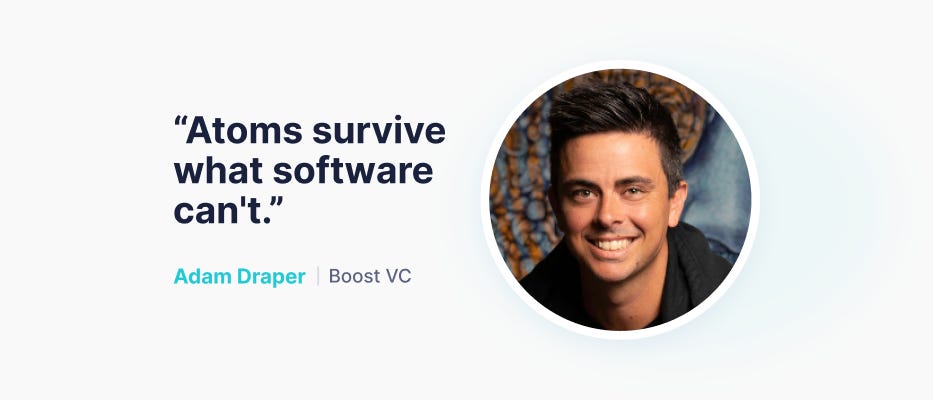
Adam Draper, Founder & Managing Director, Boost VC
“Bio is Deep Tech.” Adam’s takes come compact.
On what survives the AI wave: “Atoms-based businesses are more protected from AI’s software-killing nature, but all businesses will be transformed by AI. The adaptable survive in Software and Deep Tech.”
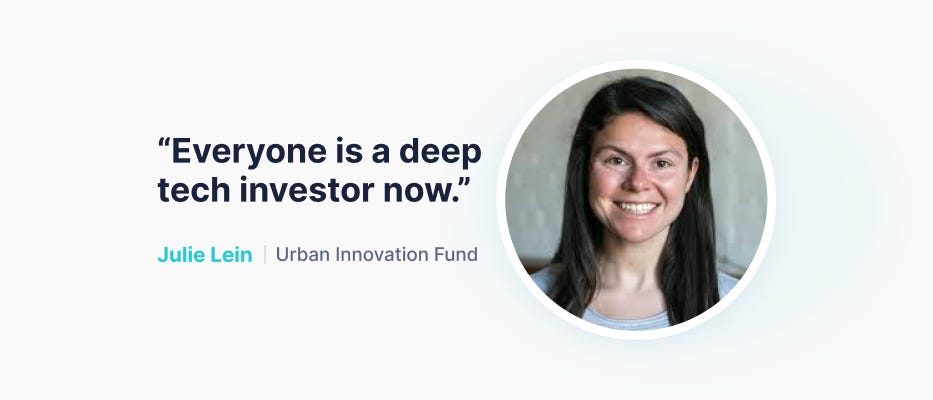
Julie Lein, Co-founder and Managing Partner, Urban Innovation Fund
“Everyone is a deep tech investor in 2026. As investors look for any startup with a shot at building a competitive moat, deep tech looks increasingly appealing to generalist VCs.”
Her second take points to where the next edge gets built. “2026 will be the year of startups working in regulated industries. As startups look for real competitive advantages, they’ll find an edge in building for highly regulated customers.” On AI, she doesn’t hedge. “I don’t see AI as a threat to deep tech. It’s unlocking transformative deep tech innovation. And that’s a good thing.”
Reilly Brennan, Partner, Trucks VC
“Automated driving is back to being the biggest opportunity in venture and 2026 feels like 2016 all over again. Even Travis is getting back in. We are seeing the ecosystem formation moment, much like we did with aviation in the 1930s.”
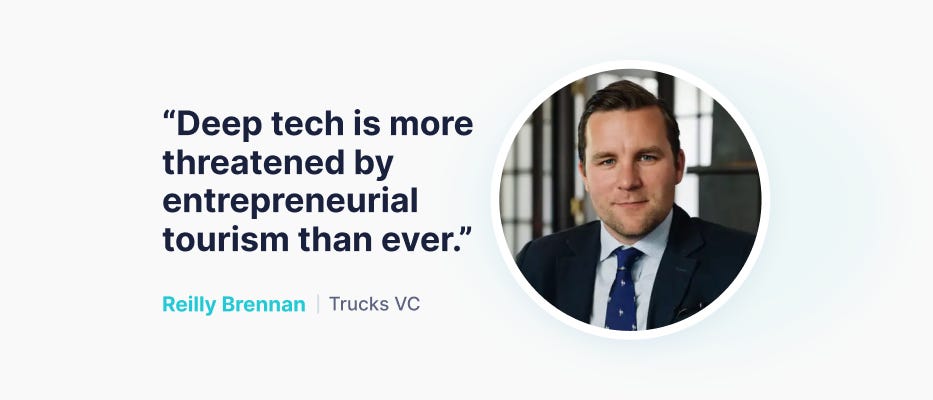
On AI, Reilly agrees deep tech is less threatened than SaaS, but points to a different risk. “Deep tech is now more threatened by entrepreneurial tourism than ever. If the costs of starting an automated driving company are down more than 10x by our measurements, you are going to have a lot more companies, which is good, and a lot lower switching costs, which can produce the TV remote control effect.”
Sunil Nagaraj, Founding Partner, Ubiquity Ventures
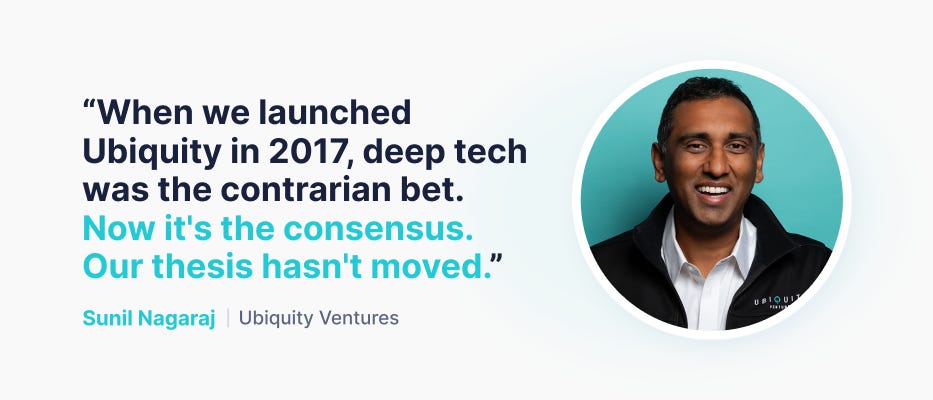
The most durable companies take software off the screen and into the physical world, where a model alone cannot win and the moat is the hardware, the proprietary data, and the domain expertise wrapped around it.
Nerdy and early, before the category is obvious.
Ubiquity Ventures is a seed-stage venture capital firm investing in software beyond the screen. We back founders building AI, software, and smart hardware for the physical world — technology you can touch, hear, and feel.
If you know a founder working on something nerdy and early, we’d love an introduction.